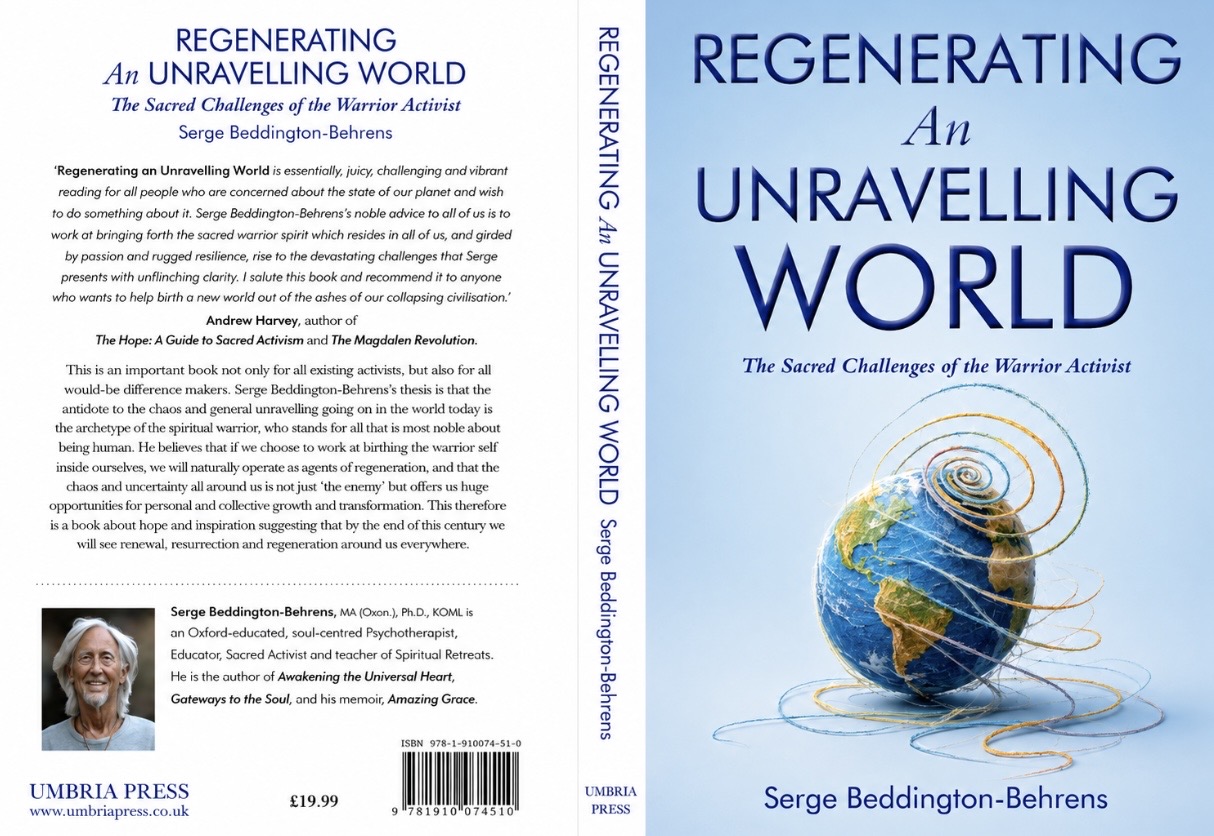
A new book by psychotherapist and spiritual educator Serge Beddington-Behrens explores an unusual idea about personal crisis: that some of the experiences we most want to escape may also contain the possibility of profound transformation.
In Regenerating an Unravelling World: The Sacred Challenges of the Warrior Activist, Beddington-Behrens devotes an entire chapter to what he calls “Fierce Grace” — the idea that grace does not always arrive in gentle or comfortable forms. Sometimes, he suggests, it appears through experiences that challenge us, unsettle our lives and force us to look more honestly at who we are.
It is a concept that sits at the heart of his understanding of the spiritual warrior.
When Grace Does Not Look Like Grace
Grace is often imagined as something comforting: a moment of peace, a feeling of connection or an unexpected piece of good fortune.
Beddington-Behrens asks readers to consider another possibility.
What if grace can also be fierce?
In the book, he describes fierce grace as having the ability to push us beyond the reality we have become comfortable with. Difficult experiences can become what he calls tests or initiations, potentially changing the person who emerges from them.
This does not mean that suffering is somehow desirable, or that painful experiences should simply be dismissed as blessings.
Instead, the question is what we do with them.
For Beddington-Behrens, the spiritual warrior learns to ask: What is this experience asking of me?
The Personal Story Behind the Idea
The concept is not presented purely as a spiritual theory.
Beddington-Behrens writes about his own experiences of crisis and how difficult periods in his life eventually created opportunities for radical changes that might otherwise never have happened.
He also describes a period of serious illness that challenged his sense of physical strength, identity and even his relationship with his own ego.
At first, the experience was understandably difficult. But looking back, he came to see it differently. He recognised that it had exposed aspects of himself that needed attention, including his attachment to his physical wellbeing and the ego that had grown around his professional success.
What initially appeared to be an enemy eventually became, in his interpretation, a kind of wake-up call.
He writes about learning to reconnect more deeply with his heart, humility and integrity as a result.
That personal honesty is important to the book’s wider argument.
Beddington-Behrens is not presenting the spiritual warrior as someone who has already mastered life. Quite the opposite. The warrior path involves continually discovering where we are still disconnected, afraid, defensive or driven by ego.
What Can Crisis Teach Us?
The idea of fierce grace becomes particularly interesting when applied to the wider world.
Beddington-Behrens believes the turbulence of the present century may itself become a kind of collective initiation.
Rather than viewing every crisis simply as evidence that humanity is failing, he asks whether these upheavals could also force us to develop qualities that have become increasingly necessary: more heart, more love, more courage, more vision and greater integrity.
This is where the concept moves beyond personal spirituality.
The world is unravelling, according to Beddington-Behrens, but he does not see this as a reason to retreat.
He sees it as a challenge.
And the way we respond to that challenge matters.
Becoming More Than We Were
Throughout Regenerating an Unravelling World, Beddington-Behrens argues that the spiritual warrior has to be willing to grow through difficulty rather than simply trying to avoid it.
The path is not about becoming invulnerable.
It is about becoming more fully human.
That means developing courage without losing compassion, strength without becoming hard, and the ability to confront difficult realities without allowing them to close the heart.
This is also why fierce grace connects directly with his wider idea of Sacred Activism. A person who wants to contribute to the regeneration of the world has to be prepared to do inner work as well as outer work. The book’s first section, Inner Activism, explores precisely this process, including disconnection, reconnection, fierce grace, the challenges of the warrior path and becoming a warrior of the heart.
The Warrior Response to Difficulty
One of the most practical aspects of the chapter is that Beddington-Behrens does not leave the idea of fierce grace as an abstract spiritual concept.
He asks readers to consider their own lives.
What challenges are they facing?
What qualities might those challenges be asking them to develop?
Could a difficult period be inviting greater patience, courage, humility, forgiveness, strength or love?
These questions are part of the exercises accompanying the chapter, encouraging readers to consider how they are currently responding to their own difficulties and whether they are becoming more capable of living as a sacred warrior activist.
The emphasis is not on pretending everything is fine.
It is on meeting reality differently.
From Personal Crisis to Planetary Regeneration
This is ultimately where fierce grace becomes part of Beddington-Behrens’ larger vision.
He believes that the crises of our time may be forcing humanity to confront aspects of itself that can no longer be ignored.
The process may be painful. It may involve the collapse of systems, beliefs and identities that once appeared secure.
But Beddington-Behrens believes that something new can emerge from this unravelling.
His vision is not simply for a new political or economic system, but for a different quality of human being — one with a more open heart and a deeper sense of connection.
That is why Regenerating an Unravelling World ultimately remains a hopeful book despite confronting subjects including war, evil, fascism, political crisis and social breakdown.
The challenge, as Beddington-Behrens sees it, is not to wait for the turbulence to disappear.
It is to ask what kind of people we can become while moving through it.
Perhaps that is the deeper meaning of fierce grace: not that everything difficult happens for a reason, but that even in the midst of difficulty, we may still have a choice about who we become.